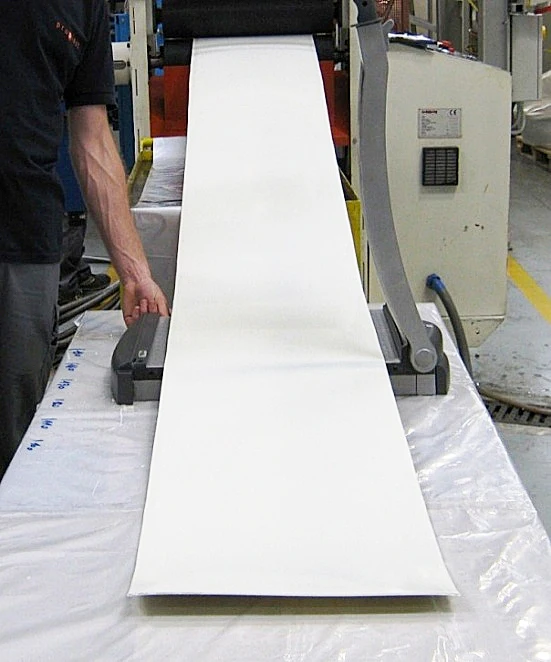
At a time when environmental sustainability was not yet central to the public debate, we took a complex, seemingly unrecyclable bilayer and transformed it into a homogeneous, impact-resistant compound, ready for industrial processing.
This was achieved through reactive compatibilizers, molecular regrading and a strong problem-solving approach.
Impact-Resistant PET–PE Recycled Compound
SPINPET’s first project and the origin of our name
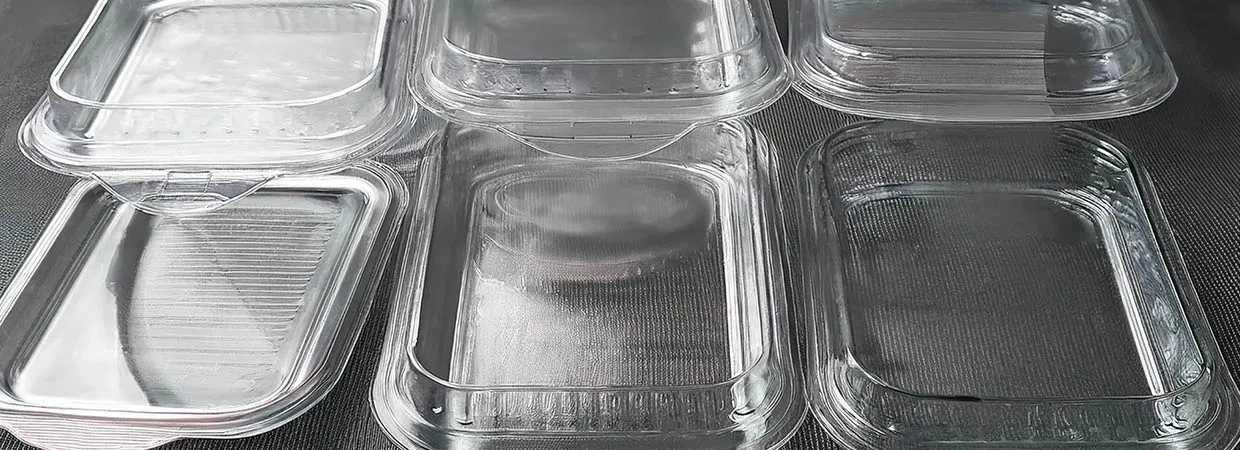
PET–PE multilayer recycling compound developed by SPINPET – Valorization of post-consumer bilayer packaging commonly used for food trays.
How we transformed a complex waste stream into a functional material: a concrete case of advanced recycling, targeted upcycling and applied innovation.
From formulation to market
Post-consumer bilayer packaging — especially PET/PE-based structures commonly used for food trays — represents a material that is extremely difficult to recycle and often considered waste with no future.
SPINPET transformed this complex waste into a functional, patented material, processable at industrial scale for applications such as thermoformable cladding for vertical surfaces in commercial environments, particularly within the retail sector.

The problem:
PET/PE/EVA, a challenging combination.
Post-consumer (and post-industrial) plastics often contain multilayer films, where:

PET
provides mechanical strength and gas barrier properties
PE
ensures flexibility and sealability
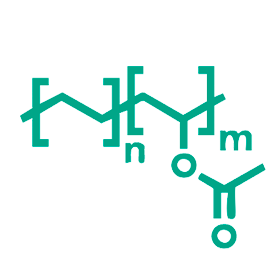
EVA
s frequently present as a tie layer or adhesive
These polymers are chemically incompatible. In addition, the presence of adhesives complicates every recycling step, resulting in materials that are non-homogeneous, unstable and mechanically weak.
The technical challenge:
compatibilization and molecular regrading.
To address these issues and obtain an Impact-Resistant PET–PE Recycled Compound, SPINPET developed a twofold technical strategy:
- Compatibilization of immiscible polymer phases.
- Molecular regrading of PET to recover properties lost along the recycling chain.
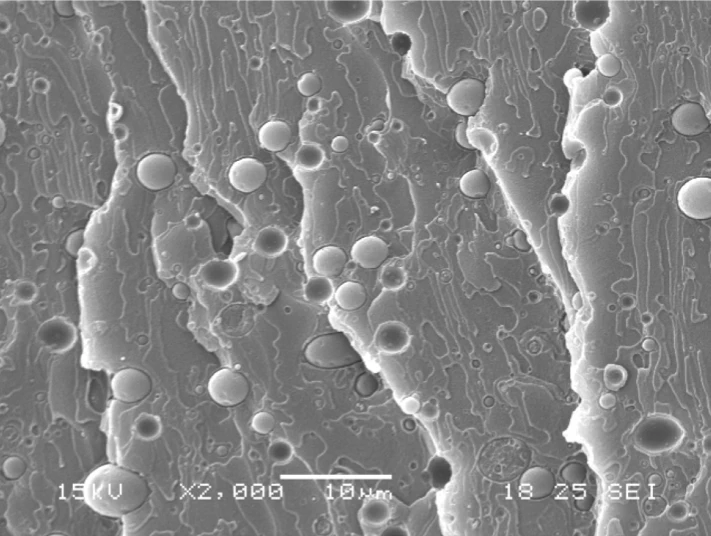
SEM of a Non-compatibilized PET-PE
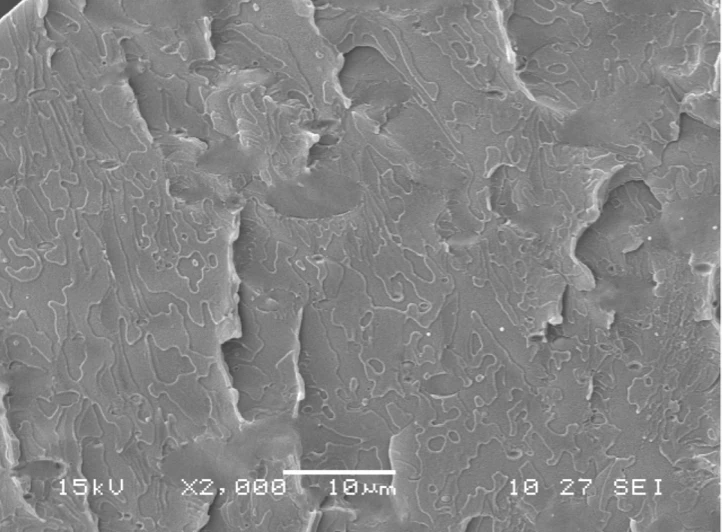
SEM of a Compatibilized PET-PE
The results:
a patented, processable, impact-resistant material.
The final formulation resulted in a flat-die extrudable compound featuring:
- excellent morphological homogeneity;
- impact-resistant properties;
- full processability on standard industrial equipment.
The technology is protected by patent ITPI20110090A1 (“Impact-resistant thermoplastic material based on polycondensation polymers and its production method”).
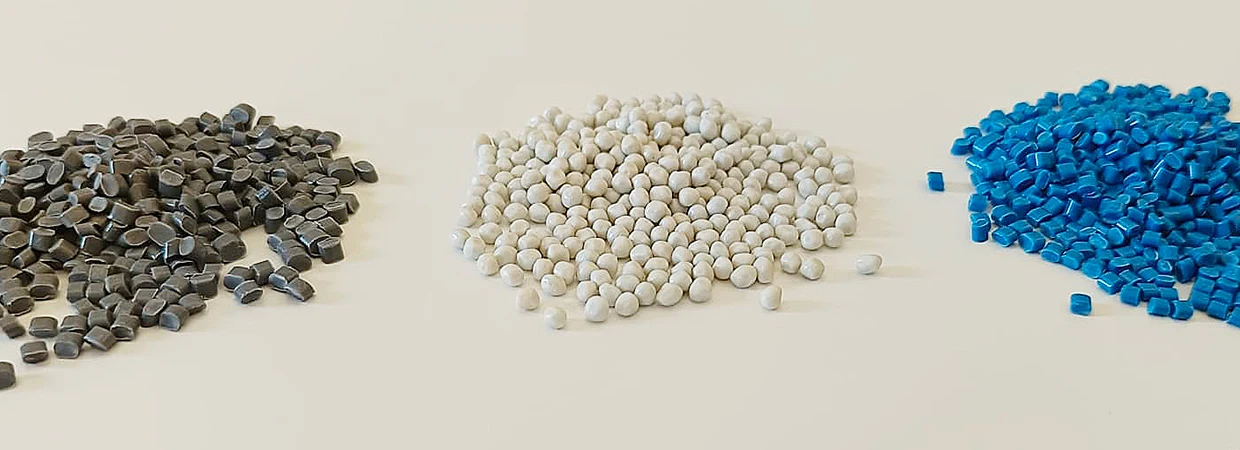
The resulting Impact-Resistant PET–PE Recycled Compound can be customized in a wide range of colors, making it suitable not only from a technical standpoint but also from an aesthetic perspective, for example in interior cladding of retail and commercial spaces, where visual performance is a key differentiating factor.
From formulation to market:
industrial network and customization.
Our work does not stop at the laboratory stage.
SPINPET works closely with compound manufacturers, providing the patented formulation and process guidelines needed to convert post-consumer material into high-performance pellets ready for final applications.
What does this project demonstrate?
- That even the most complex waste streams can be valorized through technical intelligence and industrial vision.
- That applied research can generate concrete, sustainable and scalable solutions.
- That SPINPET is the right partner for companies aiming to innovate materials starting from what is currently considered waste.